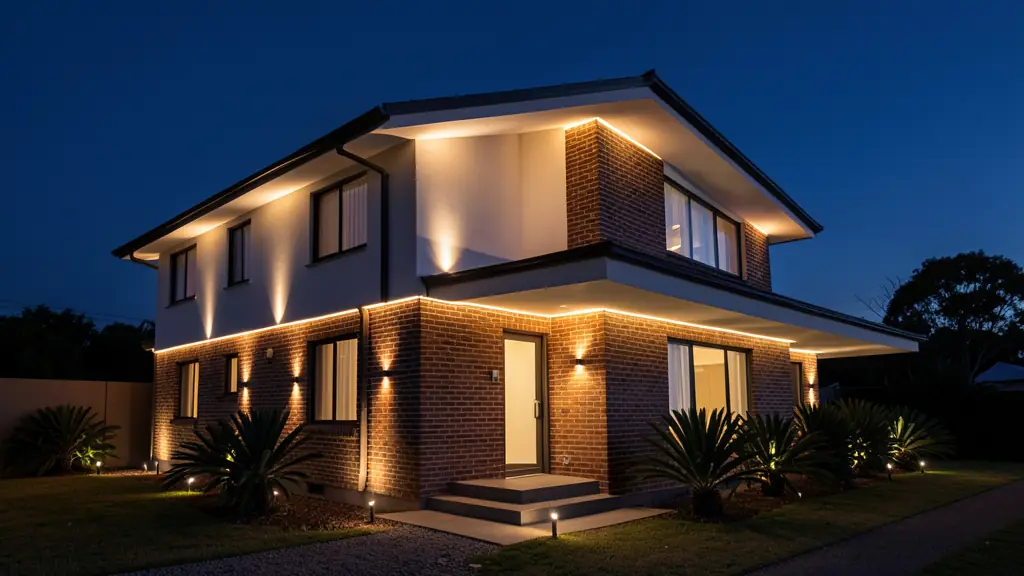
LED outdoor lighting has replaced halogen and CFL for nearly every outdoor job, because LEDs use far less power, last much longer and come in every style from wall lights to floods. Choosing outdoor lighting LED fittings well means understanding lumens, colour temperature and drivers. OutdoorLighting.co.za is a free quote service. You fill in one form, and we pass it to independent local suppliers and installers, who quote you directly. We do not sell or install anything ourselves, and there is no fee or obligation.
LED vs halogen and CFL
An LED typically uses a fraction of the power of a halogen for the same light, and lasts many times longer. That matters on rising Eskom and municipal tariffs, and on inverters during load-shedding, where every watt counts. LEDs also start instantly at full brightness, unlike CFLs, so they suit motion-sensor security lights that must react instantly when someone approaches the house or gate. Retrofit LED outdoor lighting bulbs fit old fittings, but integrated LED fittings usually manage heat and water better.
Lumens, not watts
Compare LED outdoor lights by lumens (light output), not watts. As a rough guide:
- Path and step lights: 100 to 300 lm
- Front door wall lights: 400 to 1,000 lm
- Driveway and garage: 1,000 to 3,000 lm
- Large yard flood lights: 5,000 lm and up
Efficacy, in lumens per watt, tells you how efficient a fitting is. Beam angle matters too: a narrow beam throws light far, while a wide beam spreads it evenly across a patio or yard.
Outdoor lighting 2700K vs 3000K vs 4000K
2700 K is very warm, close to old incandescent light, and suits stoeps, patios and gardens. 3000 K is the most popular all-rounder for homes and estates. 4000 K neutral white suits security, parking and commercial sites. Look for a CRI of 80 or more so colours look natural, and 90+ for plants and facades. Avoid mixing colour temperatures on one facade, as the difference is obvious at night. For bedrooms that face the garden, warmer and dimmer light near windows also helps everyone sleep.
Drivers, lifespan and solar LED
The driver converts 230 V to the low voltage the LED needs, and it is often the first part to fail, especially after surges. Quality fittings use good drivers and heat sinks, which is what lifespan claims depend on. Solar LED outdoor lighting pairs efficient LEDs with a panel and battery, and LED strip lights add soft lines under eaves and steps. Ask suppliers for surge-protected drivers in lightning-prone areas, and check that replacement drivers are available locally.
What to include in your request
- Say which old fittings or bulbs you are replacing
- Give the colour temperature you prefer
- Note the light output or area to be lit
- Ask for driver and warranty details
- Mention inverter or solar backup use
LED Outdoor Lighting for different properties
- Homes: LED wall lights, sensor floods and garden spotlights replacing old halogens
- Estates and complexes: a matched LED retrofit of unit wall lights and common-area bollards
- Farms and smallholdings: efficient LED floods on sheds and LED lamps run from solar or inverters
- Shops and offices: LED parking poles, canopy lights and facade lighting on lower tariffs
- Industrial sites: high-bay and high-output LED floods across yards and loading docks
- Lodges, guesthouses and venues: warm 2700 K LED path, terrace and string lighting at lodges and venues
- Municipalities, schools and clubs: LED street light and sports field retrofits that cut energy bills
Frequently asked questions
Are LED outdoor lights worth it?
Should I choose 2700K or 3000K for outdoor lighting?
Can I put LED bulbs in my existing outdoor fittings?
How long do LED outdoor lights last?
LED Outdoor Lighting by province and city
- Johannesburg
- Pretoria
- Centurion
- Midrand
- Sandton
- Randburg
- Roodepoort
- Krugersdorp
- Randfontein
- Germiston
- Boksburg
- Benoni
- Kempton Park
- Alberton
- Vanderbijlpark
- Vereeniging
- eMalahleni (Witbank)
- Middelburg
- Secunda
- Mbombela (Nelspruit)
- Rustenburg
- Brits
- Klerksdorp
- Potchefstroom
- Mahikeng
- Polokwane
- Tzaneen
- Kimberley
- Upington
- Bloemfontein
- Welkom
- Sasolburg
- Durban
- Pinetown
- Pietermaritzburg
- Richards Bay
- Newcastle
- Ladysmith
- Gqeberha (Port Elizabeth)
- East London
- Kariega (Uitenhage)
- Mthatha
- Cape Town
- Bellville
- Paarl
- Stellenbosch
- George
- Worcester